
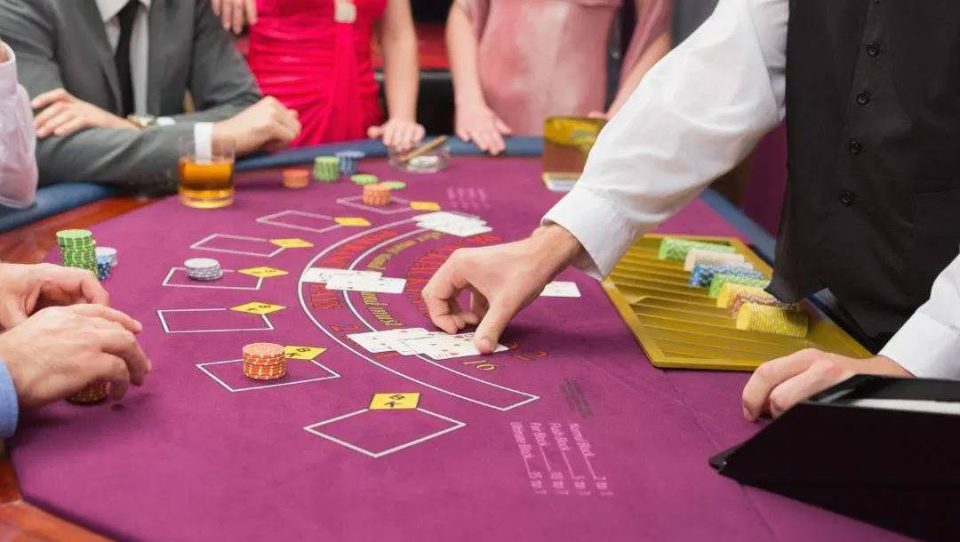
To the casual observer, blackjack looks like the simplest card game on the casino floor. You place a wager, receive two cards, and try to get closer to twenty-one than the dealer without going over. The entire transaction takes thirty seconds, accompanied by the quiet tap of felt, the click of stacked chips, and the periodic sweep of a dealer’s arm.
Beneath that relaxed surface sits an intensely calibrated operational environment. Modern blackjack is not merely a card game; it is an intricate fusion of probability mathematics, industrial security, strict physical choreography, and specialized technology. Whether played under the warm lighting of a Las Vegas casino or streamed live to a smartphone from a high-tech studio, every single movement from the first shuffle to the final payout is governed by an exacting system designed to eliminate human error and maintain statistical certainty.
The Mathematics of the Shoe and Deck Penetration
The mechanics of modern blackjack begin long before the first hand is dealt. The game is anchored by the shoe—the plastic case holding multiple decks of cards—and the specific way those cards are managed.
In early gambling history, single-deck games dealt by hand were the standard. Today, the majority of brick-and-mortar tables rely on six- or eight-deck shoes or integrate Continuous Shuffle Machines (CSMs). The primary purpose of introducing multiple decks is not simply to confuse players, but to stabilize the game’s mathematical variance and maximize table efficiency.
Where traditional batch shoes are used, the dealer cuts the combined decks with a colored plastic card before inserting them into the shoe. The placement of that cut card determines deck penetration—the percentage of cards dealt before the entire shoe must be reshuffled. A casino setting the cut card at seventy-five percent allows roughly six decks of an eight-deck shoe to be played. Controlling this depth preserves the house’s mathematical baseline by resetting card compositions before extreme distribution imbalances can develop, all while minimizing dead time spent on manual shuffles.
Continuous shuffle machines alter this rhythm entirely. By feeding discarded hands back into a motorized drum after each round, CSMs create an ongoing, virtually infinite shoe. For the operator, this eliminates shuffling downtime and keeps the house edge perpetually constant. For the player, it changes the game into a steady, uninterrupted loop of independent trials.
The Dealer as a Human Algorithm
While dealers often project a warm, conversational demeanor, their operational role is strictly procedural. A casino dealer possesses zero strategic autonomy. Every decision to hit, stand, pay, or collect is predetermined by rigid house rules, typically requiring the dealer to draw on sixteen and either hit or stand on a soft seventeen.
The Science of Physical Choreography
Because casinos operate under continuous surveillance, dealers follow precise physical protocols known as procedural dealing. Every gesture is designed to be unambiguously interpreted by ceiling-mounted cameras without needing audio verification.
-
Clear Hands: Whenever a dealer steps away from a table, scratches an itch, or touches their own clothing, they must turn their palms flat toward the surveillance camera to prove their hands are empty.
-
Hand Signals Over Voice: While players often say “hit” or “stay” out loud, dealers wait for physical hand gestures—a tap on the felt or a horizontal wave across the cards. If a dispute arises, video review relies exclusively on what the player signaled with their fingers, rendering verbal statements secondary.
-
Sequential Card Delivery: Cards are slid from the shoe with specific finger placements, face down or face up depending on regional rules, and positioned in uniform geometric patterns across player spots.
-
Chip Handling: Payouts are never handed directly to a player. Chips are laid out in a clean stair-step pattern on the felt directly beside the original wager so that cameras can independently count the denominations before the player picks them up.
Dealers essentially function as physical execution engines for the house rules. Their value lies in flawless consistency, manual dexterity, and the ability to maintain speed without sacrificing protocol.
Invisible Technology at the Physical Table
The modern green-felt table looks timeless, but it conceals an array of electronic monitoring tools developed to safeguard the integrity of the game.
The most universal innovation is the optical hole-card reader, often called a peeking device. When the dealer’s upcard is an Ace or a ten-value card, the dealer slides their face-down card into a small prism or electronic scanner built flush into the table surface. The device uses optical sensors to read specific corner marks, checking exclusively for a natural blackjack. It signals the dealer through an LED indicator without displaying the card’s actual rank to the dealer or the table. This prevents the dealer from inadvertently signaling card values through body language and ends the hand instantly if the house has a natural, saving everyone wasted bets on splits or double-downs.
High-limit rooms frequently employ RFID-enabled gaming chips. These chips carry tiny embedded transponders that transmit unique serial numbers and cash values to receivers hidden underneath the betting circles. Table managers and pit bosses can instantly see exact drop values, verify authentic wagers, detect counterfeit markers, and monitor player turnover without manually counting stacks. Combined with automated shoe scanners that verify the presence of every card in the deck, modern tables operate with the data precision of an airport logistics terminal.
The Digital Transition: How Live-Dealer Blackjack Operates
The newest frontier in blackjack operations is the live-dealer studio. These facilities merge real human dealers with real-time digital wagering interfaces, allowing thousands of remote players to participate in genuine physical deals.
To make this work seamlessly, physical decks are printed with oversized barcodes or optical character recognition markers along their faces. As the dealer slides each card across the shoe’s integrated scanner, the physical card is read in milliseconds. Specialized optical recognition software translates the draw into data packets, which instantly generate high-definition digital overlays on the player’s screen.
When a player clicks “split” or “double” on a phone hundreds of miles away, the dealer receives immediate visual instructions on a monitor mounted just off-camera. The dealer executes the physical card placement while the game engine automatically handles chip calculations, payouts, and side-bet settlements in the software layer. This hybrid model preserves the trusted tactile nature of physical cards while leveraging the instantaneous settlement capabilities of digital computing.
The Balance of Pace and Precision
Blackjack endures because it balances simplicity for the player with disciplined structure behind the scenes. Behind every split pair, doubled wager, and dealer bust lies an intricate infrastructure of mechanical shuffle dynamics, automated scanning devices, and strict bodily discipline.
When you sit at a blackjack table, you are participating in a performance where nothing is left to chance except the order of the cards themselves. Understanding how the shoe is configured, how the dealer is trained, and how modern sensors track every wager reveals that blackjack is less about luck and far more about the smooth, unbroken execution of mathematical procedure.
