
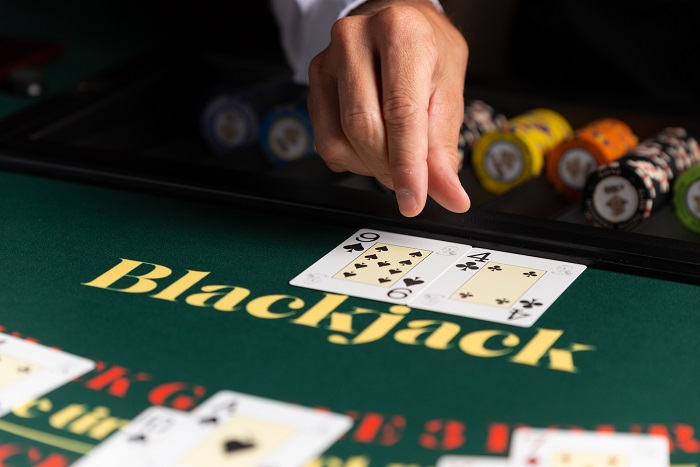
On paper, blackjack is a solved equation. Decades of combinatorial analysis and billions of simulated computer hands have mapped out the mathematically optimal action for every conceivable scenario. The dealer shows an eight, you hold a twelve, and the arithmetic insists you hit. On a static strategy chart, the path forward is absolute, devoid of doubt, and completely indifferent to human emotion.
Step onto a live casino floor or join a high-tempo virtual table, however, and the nature of the game changes completely. The clean lines of probability suddenly collide with the messy realities of human psychology, social pressure, and split-second time constraints. What feels effortless under calm study becomes genuinely stressful when real capital is at stake, the dealer is waiting, and fellow players are watching your every move. Understanding how blackjack really works requires mastering this exact intersection: the friction between rigid mathematical theory and the volatile environment of real-time execution.
The Mathematical Baseline and the Logic of Expected Value
At its core, basic strategy is not designed to guarantee that you win any individual hand. Instead, it is an exercise in managing expected value, which measures the average financial return of a specific decision over hundreds of thousands of identical repetitions.
In blackjack, expected value is often about damage control rather than runaway victory. Because the house retains a structural edge by forcing the player to act first, many hands present scenarios where every available option carries a negative expected return. If you stand on a pair of sevens against a dealer’s ten, your expected value is negative. If you hit, it remains negative.
The purpose of mathematical strategy in that spot is to choose the path that loses the least amount of money over time. Mathematical discipline demands that a player willingly take an action with a forty-percent chance of winning over an alternative with a thirty-five-percent chance, even when losing feels like the probable short-term outcome. Over a single evening of play, the difference between those percentages can feel invisible. Over a lifetime of play, that subtle difference is the exact boundary between a modest house edge of roughly half a percent and a catastrophic edge of three to five percent.
The Counterintuitive Spots Where Human Instinct Resists Math
The primary challenge of executing basic strategy is that the mathematically correct move frequently contradicts common sense. Human self-preservation favors caution, and caution at a blackjack table is often expensive.
Navigating the Dreaded Hard Sixteen
There is no hand more psychologically agonizing than a hard sixteen against a dealer’s seven, eight, nine, ten, or ace. When looking down at a ten and a six, your natural instinct is to preserve what you have. Hitting carries a roughly sixty-two percent chance of busting immediately. Standing keeps you alive, offering the comfortable illusion that the dealer might bust instead.
The mathematics, however, paints an uncompromising picture. While hitting busts you nearly two-thirds of the time, standing against a dealer showing a seven or higher loses at an even more punishing rate. A dealer with an upcard of seven through ace will make a legitimate standing total far more often than they will bust. Hitting on sixteen against strong dealer cards feels terrible because the failure is immediate and self-inflicted, but standing is mathematically worse because it hands the round to the dealer on a silver platter.
The Counterattack: Splitting Eights and Doubling Soft Totals
A similar psychological disconnect occurs when facing offensive opportunities. A pair of eights totals sixteen—the weakest starting hand in the game. When the dealer shows a nine or a ten, casual players often balk at the mathematical mandate to split the pair. Splitting forces you to post an additional wager, effectively putting twice as much money at risk against a powerful dealer card.
Yet the math remains unambiguous. A hard sixteen is a structural loser. By splitting the pair of eights, you break up a catastrophic total and create two independent hands, each starting from an eight, which provides a far better statistical foundation to draw to an eighteen. You are not splitting because you expect to win both hands effortlessly; you are splitting because two independent hands starting at eight yield a significantly higher expected return than a single hand locked at sixteen.
Soft hands generate a comparable hesitation. Holding an ace and a seven against a dealer’s six is already a solid total of eighteen. Handing over another stack of chips to double down feels reckless to players who view eighteen as an accomplishment. But against a dealer’s six—the statistically weakest upcard on the board—doubling exploits the dealer’s high bust probability while giving the player a free roll to build an even stronger holding. Mathematics rewards aggression precisely where the dealer is most vulnerable.
Real-Time Friction: The Psychological Pressures of the Table
The gap between knowing the right move and executing it is widened by the sensory and social environment of the game. Casinos are engineered to disrupt analytical thought, utilizing ambient noise, continuous pacing, and social dynamics that tug at a player’s focus.
-
The Illusion of Table Solidarity: In physical gaming spaces, an unwritten superstition often dominates the conversation: the belief that the player in the final seat, commonly known as third base, controls the fate of the table. If that player hits their hand and draws a ten, only for the dealer to subsequently pull a five to make twenty-one, the table often blames the third baseman for taking the dealer’s bust card. In reality, cards are distributed randomly, and downstream decisions have zero predictable mathematical impact on the dealer’s outcome. Yet the fear of social disapproval regularly causes players to abandon optimal# Blackjack Decision-Making: When Mathematics Meets Real-Time Gameplay
On paper, blackjack is a solved puzzle of finite outcomes. Every card remaining in the shoe possesses a measurable likelihood of appearing, and every two-card starting hand paired against a dealer upcard has an objective, mathematically optimal response. Decades of computer simulations and combinatorial analysis have reduced the felt table to a clean, elegant matrix of expected value.
Yet anyone who has sat in the third-base seat under the bright glare of casino lights knows that the mathematics rarely feels simple in the heat of the moment. The split second between a dealer waiting for your hand signal and your brain processing a stiff sixteen against a dealer’s face card is where theory meets human psychology. Real-time gameplay introduces variables that static charts never capture: ticking digital clocks, social pressure from fellow players, fluctuating chip stacks, and the visceral sting of a losing streak. Mastering blackjack is not simply an exercise in memorization; it is the discipline of executing cold probability when your instincts are screaming to do the opposite.
The Deterministic Core: Understanding Expected Value
At its core, standard blackjack strategy is not about predicting the next card. It is an exercise in expected value, the average outcome of a given decision repeated over thousands of iterations. Every choice to hit, stand, double, split, or surrender is calculated to either maximize long-term gains or, just as frequently, minimize unavoidable losses.
A common misconception among casual players is that basic strategy guarantees winning hands. In reality, several mathematically correct plays are purely damage-control maneuvers. When you hold a hard sixteen against a dealer’s ten upcard, you are statistically disadvantaged regardless of your decision. Hitting will cause you to bust roughly sixty-two percent of the time. Standing, however, yields a loss roughly seventy-seven percent of the time because the dealer’s concealed downcard and subsequent draws so frequently produce seventeen or better. The mathematical instruction to hit is not a promise of victory; it is a calculated decision to save fifteen cents on the dollar over the long run.
Accepting this mathematical premise requires uncoupling your emotions from immediate outcomes. In a live environment, watching a newly drawn five turn your sixteen into a twenty-one feels like a stroke of genius, just as drawing a king and busting feels like a disaster. The math does not care how the individual hand concludes. It evaluates the wisdom of the decision strictly at the moment the wager was struck.
The Psychological Friction Points of Live Play
When seated at a live table, cognitive biases constantly threaten to undermine optimal play. The friction between human emotion and strict mathematics usually manifests in three distinct scenarios where players consistently abandon their training.
The Paralyzing Fear of the Self-Inflicted Bust
Psychologists refer to omission bias as the tendency to judge harmful actions as worse than equally harmful inactions. At the blackjack table, this bias reigns supreme. Standing on a stiff hand like twelve, thirteen, or fourteen against a dealer showing a high card guarantees that the player will not personally trigger the loss. If the dealer flips a twenty and sweeps the chips away, the player perceives it as bad luck or dealer strength.
Conversely, hitting that same hand and catching a ten-value card creates an immediate sense of personal culpability. You busted yourself. To avoid that uncomfortable feeling of self-sabotage, players routinely stand on hands they ought to hit, surrendering substantial mathematical value simply to shift the psychological burden of losing entirely onto the dealer.
The Reluctance to Double on Vulnerable Soft Hands
Soft hands—those containing an Ace counted as eleven—represent some of the highest-leverage opportunities in blackjack, yet they are notoriously mishandled under pressure. Doubling down on a soft eighteen against a dealer’s five or six frequently induces panic in casual players.
From an intuitive standpoint, an eighteen looks like a respectable total, and putting twice as much money at risk when an errant low card could leave you with a weak fourteen seems reckless. But probability views the scenario differently. The dealer’s weak upcard puts them at a severe risk of busting, while your soft total gives you a free shot at improving without the risk of an immediate bust. Bypassing the double-down to simply stand preserves short-term comfort at the direct expense of long-term profitability.
Counterintuitive Defensive Splits
Splitting a pair of eights against a dealer’s nine, ten, or Ace is perhaps the most emotionally grating play in the entire basic strategy repertoire. A player holding sixteen is already in an unenviable spot; committing an additional bet to create two separate hands starting at eight feels like doubling down on misery.
The arithmetic, however, is clear. A hard sixteen is the weakest starting hand in the game. By splitting the eights, you transform a singular catastrophic scenario into two independent opportunities to catch a ten or an Ace and build a workable total. It remains an uphill battle, but splitting significantly outperforms standing or hitting the single sixteen over time.
Accounting for Table Dynamics and Rule Nuances
Executing disciplined strategy in real time requires more than just knowing what to do with primary hand combinations; it requires adjusting to the specific operating rules of the table you chose. Minor variations in table rules fundamentally alter the underlying mathematics, and playing without adjusting for them quietly drains a bankroll.
Dealer Actions on Soft Seventeen
One of the most consequential yet frequently overlooked rules is whether the dealer must hit or stand on a soft seventeen. In a game where the dealer stands on all seventeens, the house edge is noticeably lower. When the dealer is required to hit soft seventeen, the casino’s advantage increases because the house gets a second chance to improve a mediocre total into an eighteen through twenty-one. This subtle rule change alters specific peripheral decisions, such as whether to double on an eleven against an Ace or how to handle certain soft doubles against dealer mid-cards.
Surrender and Payout Erosion
Where available, late surrender provides an invaluable escape hatch for the worst starting situations. Sacrificing half your wager to surrender a hard sixteen against a nine, ten, or Ace is a mathematically sound maneuver that immediately plugs bankroll leaks. Yet many players dismiss surrender as an act of defeat, preferring to play out the hand and giving back valuable expected value in the process.
Even more critical is the table payout structure. The proliferation of six-to-five blackjack payouts over traditional three-to-two odds dramatically shifts the mathematics. In a six-to-five game, a natural twenty-one on a ten-dollar wager pays twelve dollars instead of fifteen. This seemingly modest adjustment increases the house edge by roughly fourfold, rendering even the most flawless real-time decision-making mathematically unsustainable over sustained play.
The Discipline of Process Over Outcome
The ultimate test of real-time blackjack decision-making is emotional stamina. During an adverse run of variance—where correct double-downs consistently pull low cards and dealer upcards regularly turn into miraculous twenty-ones—the temptation to abandon structured strategy becomes overwhelming. Players begin following gut feelings, raising bets erratically to chase deficits, or taking ill-advised insurance wagers because they feel a ten is due.
Every freshly shuffled deck has no memory of the preceding hand. The mathematical advantage held by the house or conceded to the player does not flex based on whether you won or lost the last five rounds. Treating blackjack as a disciplined pursuit demands adopting a process-oriented mindset: evaluating your play not by the size of the chip stack when you leave the table, but by the mathematical accuracy of every individual gesture made along the way. When probability governs the foundation and emotional detachment dictates the execution, the gap between theoretical mathematics and live gameplay finally closes.
